RF over Fiber

RF over fiber is where you modulate an RF signal onto the light beam and thus transmit it at a lower loss over a long distance.  It is an analog usage as opposed to a digital one as used in data transmission such as an ethernet extender. I have found some equipment for doing this but have not yet found anything that appears it will do the full Internet + Cable TV solution to extend the pole to internet modem solution that is cheap enough to use.

Research Links

Conclusions

For now this is not a viable solution to the house in the forest long internet cable extension problem.  It will probably get there soon though.
Using WinSmith Program to Design Matching Circuit of 900MHz ISM Band Power Amplifier

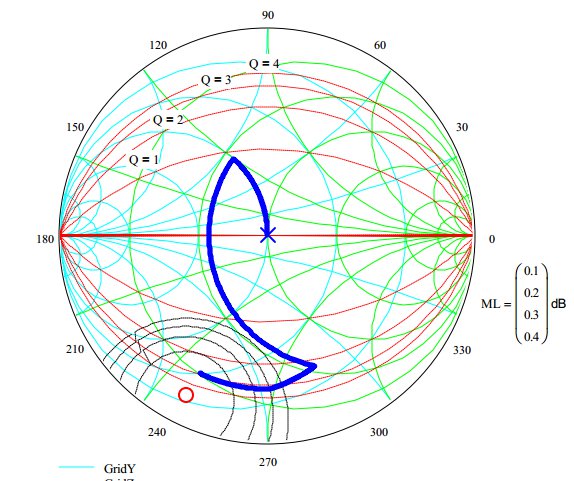
WinSmith is a Smith chart match calculating program.  The starting point is 8 – j16 ohms @ 915MHz.  Both the blue and the green curves start at this point at the lower left of the curves.  Click on the image to see a bigger version

DrainMatching_MW7IC915NT1_WS

What is interesting about the above plot is that the elements work orthogonally.  That is to say for any point selected by component of move #2 or move #3 work independently.  

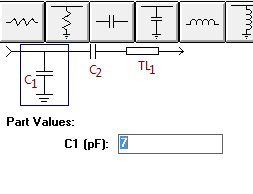
The matching circuit is shown below:

DrainMatchingCircuit    

Nominal values

  • TL1:  45 degrees of 50 Ohm transmission line @ 900MHz
  • C2:   25pF 
  • C1:   7pF

The left side is 50 Ohms match and the right side is what presents a conjugate match to the FET IC drain circuit.  Move #1 on the Smith chart is the 45 degrees of 50 Ohm characteristic impedance transmission line.

Tuning Procedure- theoretical

  • The output load of the FET MMIC amplifier will vary somewhat.  In spite of this the 45 degrees will transform the load to a region in the charge where the two caps can move the load to the close to the center of the chart.
  • C2 has one job only:  move the load to a 0.02 conductance circle on the Smith chart.  This is the conductance circle that corresponds to 50 Ohms in shunt.  Once you know the value of this capacitor you solder in place and leave it.
  • C1 is used in shunt to bring the whole thing to the center of the chart.  A calculated value can be used for a first try.  You may need to cut and try to get absolute optimum on your lab model.  

Input Match

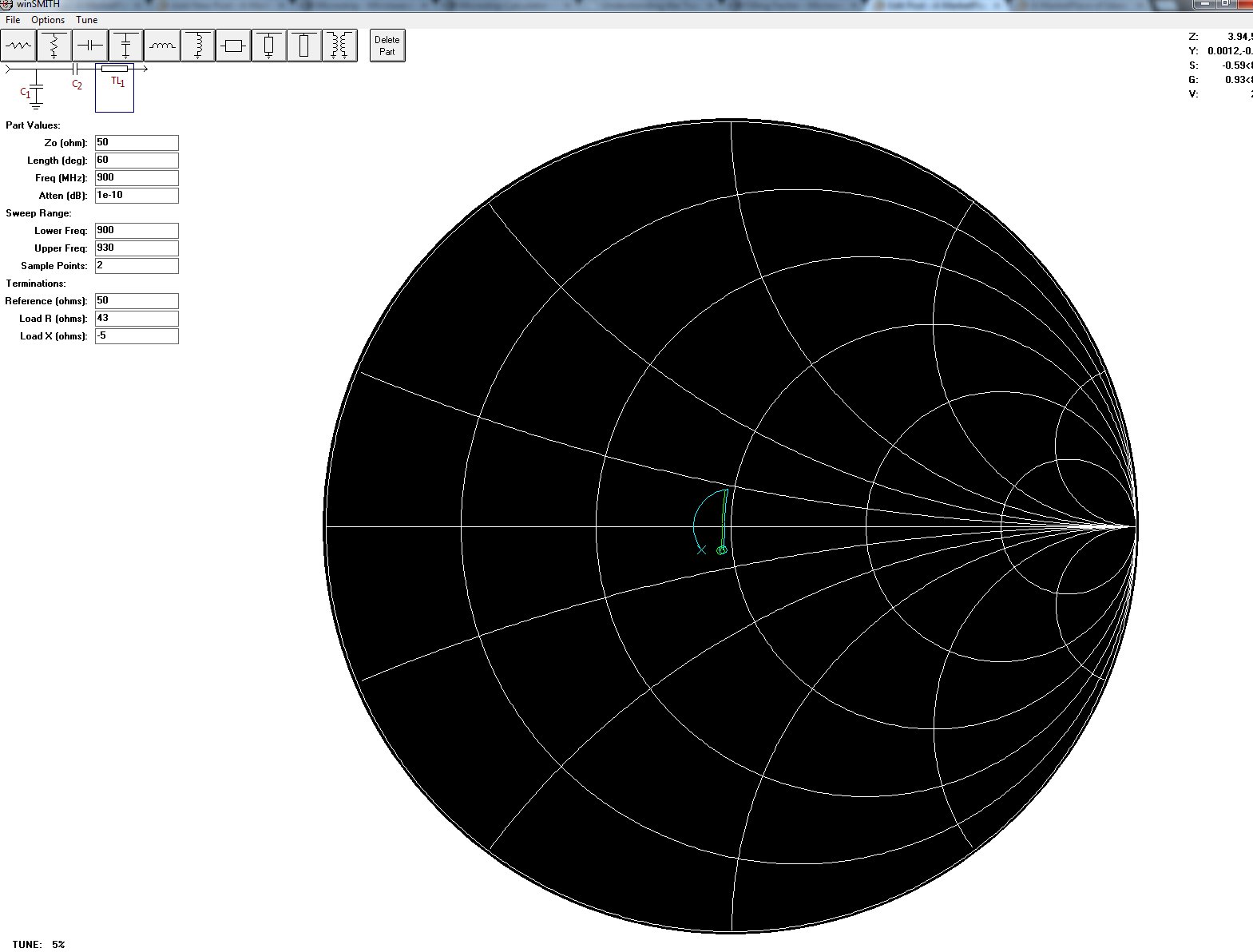
The input match is the same topology.  It starts much closer to 50 Ohms.  The nominal values are

  • TL1: 60 degrees of 50 Ohm line at 900MHz
  • C2: 22pF 
  • C1: 0.5pF – This is placeholder in case of surprises.  The match looks accomplished without it.

MW7IC_InputMatch

Links

Microstrip Filling Factor versus Relative Dielectric Constant Given fixed Line Impedance

Research Links

The question arose given a fixed microstrip transmission line characteristic impedance how does the percentage of the field in the substrate change? This is called the filling factor:

Keff=ER*FF+1x(1-FF)

It is the fraction of the field in the substrate.  I calculated the following values:

  • FF=(Keff-1)/(ER-1)
  • Dk=4 Z0=51 Deff = 3.07 which yields a filling factor of 0.69
  • Dk=10 Z0=50.5 Deff = 6.72 which yields a filling factor of 0.635

Thus it appears that the filling factor goes down with Dk as Z0 is held constant.

GNU Radio

Research Links

GNU Radio is a free & open-source software development toolkit that provides signal processing blocks to implement software radios. It can be used with readily-available low-cost external RF hardware to create software-defined radios, or without hardware in a simulation-like environment. It is widely used in hobbyist, academic and commercial environments to support both wireless communications research and real-world radio systems.


GNU Radio hardware

gnuradio_board

Universal Sofware Radio Peripheral (USRP)

  • 2 x AD9862 codec: each 2 A/D 12 bit, 64 Megasamples/sec; 2 D/A, 14 bit, 128 Ms/sec
  • FPGA: Altera Cyclone EP1C12, 64 MHz, 12,060 LEs, 239,616 RAM bits
  • USB 2.0, Cypress FX2
  • 4 x daughterboards for signal conditioning

Available from Ettus Research LLC, but design is open source.

Newer USRP2 has 100 MHz converters, much larger Xilinx FPGA