Imaginary interest rates | Ep. 5 Lockdown live math
In this video this relation is used
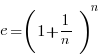 as n goes to infinity
and
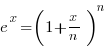
you can see easily by expanding the right hand side that

From this relations you can easily see that you reach the complex number  by a sequence of infinitesimal angular steps with in this case x being the angle on the unit circle.

An interesting thing about
is that you can see the coefficients by the following method:
to expand 
- degree zero term: 1 * 1 * 1 * 1 ….*1 with n ones
-
degree one term
 with n positions of x meaning the result is
-
degree two term
 with n-1 positions of x meaning the result is
With the n factorial term coming from the multiple count of the same positions.
Now due to the double counting of the terms in the 2nd degree tally you need to divide by 2!. In fact for each degree you must divide by n! to back out the multiple counting.

Nice. Can’t ya use LaTeX to write yer equations on yer blog like I do:
https://phxmarker.blogspot.com/2021/05/just-for-latex-practice-defintion-of.html
Right click on the equation to see MathJax info etc
& LaTeX reference:
https://en.wikibooks.org/wiki/LaTeX/Mathematics
There is LaTex in this post. But I can not in the title so far as I know.