Conversion of Optical Photons into Electrical Photons as might occur in a battery

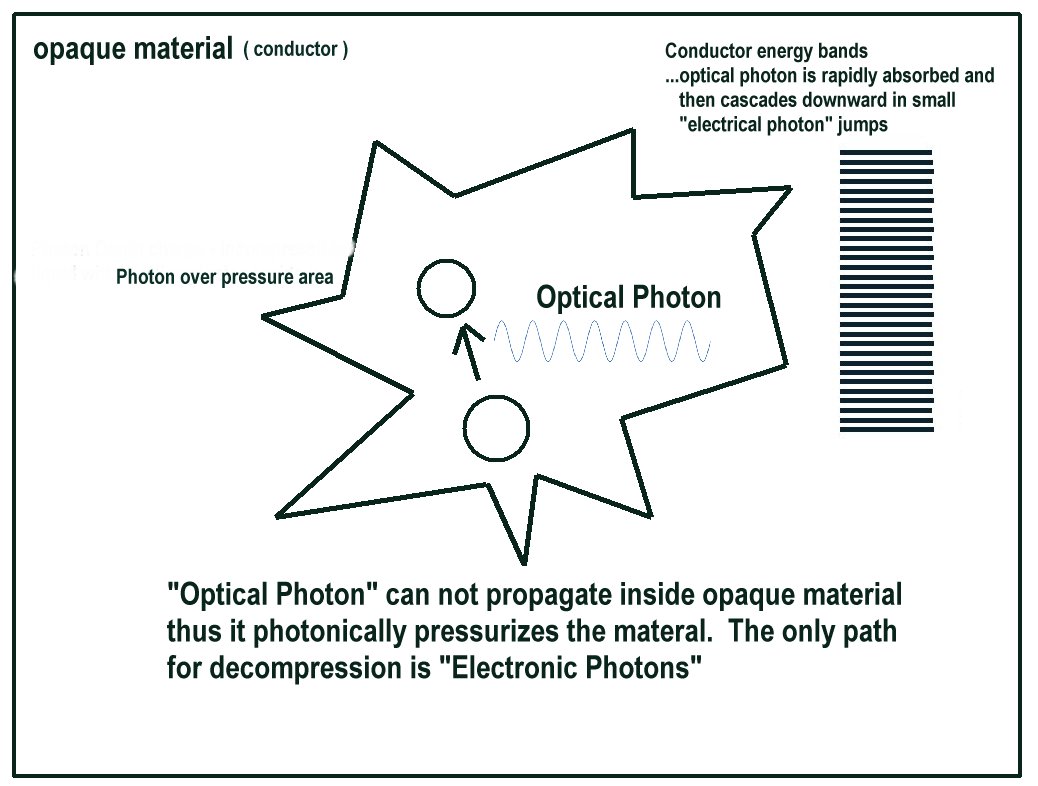
See previous post on how a battery and electrical condustors work.  In that post it describes a process in which a visible light photon is generated inside a battery by the 1.5 volt chemical reaction.    I was curious when I wrote that how the optical photon could be converted to an electrical photon.  The above diagram gives a possible explanation how that could occur. When you have an optical photon generated inside of an opaque material it can not propagate very far.   It forms a region with increased photonic pressure.   It is absorbed at some high level excited state of a charge carrier.  It then can cascade downwards in the small steps of the conduction band.  This allows the energy to propagate along the copper in the form of electrical current.

You can also imagine a solar cell acting in a similar fashion with the source of the optical photon being sunlight instead of chemical energy of the battery.

Rice and Garbonzo Beans

If you have rice and garbanzo beans already prepared this one is very quick to prepare.?
Ingredients

  • Rice – my preference is Basmati rice
  • Olive Oil – the whole thing rides on the flavor of the olive oil so get one you like the flavor of
  • garbanzo beans – should be pressure cooked on the order of 20 minutes to get a nice soft texture
  • salt – I use 1/2 sodium 1/2 potassium salt

Put the rice and garbanzo beans in a bowl and dribble olive oil over it.  Lightly salt. 

Healthy Cracker Substitute

What are crackers? They are salt, carbohydrate and fats in the form of oils right?  Why not do a gluten free version of the same thing. 


Ingredients

  • Rice – my preference is Basmati rice
  • Olive Oil – the whole thing rides on the flavor of the olive oil so get one you like the flavor of
  • salt – I use 1/2 sodium 1/2 potassium salt

Put the rice in a bowl and dribble olive oil over it.  Lightly salt.  Good Cracker!

How do electrical conductors work?

My previous inquiry into how batteries work to produce power lead me to a new question:

    How does the power produced in a battery propagate along a copper wire conductor when the 1.5 volt battery potential yields a visible light photon that is known NOT to propagate in a metal?

The following auxiliary questions arise and are answered by the above

-1- What is "DC" current?   ………  DC is a reservoir of electrons transitioning from the higher energy state to the lower and supplying the "bump" a photon supplies to the load.

-2- Why is high voltage more efficient use of power for long distance transmission?  Lower "current" is equal to saying "lower rate of electron transition which means less interaction with the elements of the lattice.  Each interaction carries a probability of bleeding off some of the energy as heat.

-3- what is voltage and current as classically used terminology? Voltage is the same as classically described.   Current is not really a flow of charge past a point but rather the rate of energy level transitions at that point
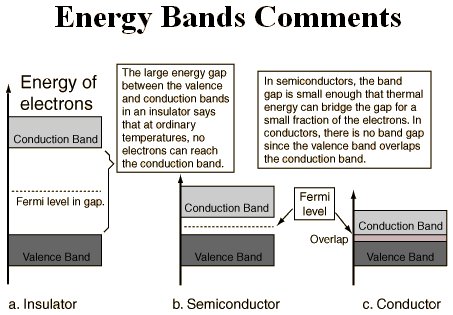
 

The probability of transition from valence band to conduction band goes down with increasing energy gap.  Why does this affect conduction?  See the next diagram.  The circles are base states of electrons. The figure eights are the first excited state of an electron.  These states are used in a representative fashion to depict relative energy levels and should not be interpreted too literally.

\

Observations

  • A conductor or semiconductor sets up a wave guide for the propagation of a photon
  • In a semiconductor the photon must be the result of a 0.7 volt electron volt potential drop more or less to exceed waveguide cutoff frequency
  • In a conductor there is no forbidden band due to the conduction and valence band overlapping.  Thus waveguide cutoff frequency is more or less 0 hertz   
VB6-CoolMenu

CoolMenu – Menus & Toolbar  you can place anywhere including a UserControl and Top / Bottom / Left / Right

Current research bookmarks

  • http://www.vbaccelerator.com/home/vb/code/controls/Menus/Popup_Menu_ActiveX_DLL/article.asp
  • http://www.vbaccelerator.com/codelib/comctl/retbar.htm
  • http://www.vbaccelerator.com/home/VB/Code/Controls/Menus/Icon_Menu_Control/article.asp
  • http://www.vbaccelerator.com/home/vb/code/controls/toolbar/vbaccelerator_toolbar_and_coolmenu_control/article.asp