Derivation of Nyquist 4KTBR Relation using Boltzmann 1/2KT Equipartition Theorem
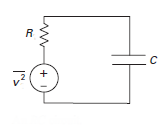
Steps
- Derive the value of the square of the voltage on the capacitor
- Assume the noise voltage on the resistor can be faked up and simulated by an equivalent voltage source driving the circuit with a noiseless resistor. The ideal source is assumed to have uniform power spectral density.
- Equate the value of the voltage on the capacitor with that given by Boltzmann's equipartition theorem and try not to get hanged in the mean time.
Equipartition Theorem: Each orthogonal degree of freedom gets 1/2KT of energy. This can be thought of as maximum entropy using uniform distribution over each axis. Look for the quadratic energy terms. With a capacitor all you have is: 


Now the circuit analysis
P.S.D. == Power Spectral Density
PSD(Capacitor Voltage) = PSD(Ideal Voltage Source) * ( Frequency response of the RC circuit ) …….this is in the frequency domain



Total energy on the capacitor is the integral [0,infinity]
 The integral of this is arctan()

The value on the left hand side is the previous value we deduced using Boltzmann:


Which yields the relation between noise voltage, bandwidth and resistance.

Research Links
- Wikipedia: Equipartition Theorem
- Equipartition Theorem: Valance
- Several different approaches to deriving the noise relation including the one taken by Nyquist – Nyquist approach includes black body radiation concept.
- A brief history of the events leading up to the discovery of thermal noise

Quantum Mechanics Table of Contents TOC
- Quantum Mechanics Table of Contents TOC
- ASU Quantum Mechanics for Engineers 434 Notes from Year 2001
- Book: Advanced Quantum Mechanics – Freeman Dyson
- Book: Notes on Quantum Mechanics
- Quantum Mechanics Entanglement and Quantum Computation Summary List
- Quantum Mechanics and Entanglement Experiment with Single Photon Detector
- Summary Outline of Richard Feynmans Thesis – Framework for learning QED and Quantum Mechanics in general
- Quantum Computing Video strips down computing mechanics explanation to minimum
- Quantum Mechanics Computing for Computer Scientists
- Quantum Mechanics Money from Knots
- Quantum Mechanics Logic
- Video: Erann Gats explanation of quantum entanglement, measurement and interpretations
- Leonard Susskind Quantum Entanglement Lecture 2006
- Quantum Mechanics Entanglement and Spooky Action at a distance
- Quantum Computing Parallelism Explained
- On the Theory of Quanta Louis-Victor de Broglie 1892-1987
- Entangled-Light-Emitting Diode
- PAM Dirac Lectures in New Zealand 1975
- Leonard Susskind Lecture Series Play Lists
- Video: Spooky Actions At A Distance?: Oppenheimer Lecture – David Mermin – and Rhetorical Homework Problem Solution
- Lectures on Quantum Computation by David Deutsch – Includes Best Grover Search Algorithm Explanation Unit 6
- Basic Polarized Photon Entanglement Experiment
- Private: Quantum Computing Book Collection
- Video: KITP Lecture : Putting Weirdness to Work: Quantum Information Science
- Private: Derivation of the Planck Relation and Maximum Entropy Principle
- Derivation of Nyquist 4KTBR Relation using Boltzmann 1/2KT Equipartition Theorem
- Heuristic method of understanding the shapes of hydrogen atom electron orbitals
End TOC
Maximum Entropy Principle Table of Contents TOC
- Maximum Entropy Principle Table of Contents TOC
- Private: Derivation of the Planck Relation and Maximum Entropy Principle
- Maximum Entropy Distribution for Random Variable of Extent [0,Infinity] and a Mean Value Mu
- The Maximum Entropy Principle – The distribution with the maximum entropy is the distribution nature chooses
- Use of Maximum Entropy to explain the form of Energy States of an Electron in a Potential Well
- Langrange Multiplier Maximization Minimization Technique
- Derivation of Nyquist 4KTBR Relation using Boltzmann 1/2KT Equipartition Theorem
- Heuristic method of understanding the shapes of hydrogen atom electron orbitals
- Derivation of the Normal Gaussian distribution from physical principles – Maximum Entropy
End TOC